Sigiriya is one of those places where the photographs genuinely underrepresent the experience. The rock rises 200 metres from a completely flat jungle floor, abruptly, dramatically, as if placed there deliberately. At sunrise, with mist still lying in the valleys below and the first light catching the ancient frescoes on the rock face, it is one of the most arresting sights in Asia.
The climb takes 45 to 60 minutes each way and involves steep staircases, narrow ledges, and one genuinely vertiginous section near the summit, none of which is difficult if you are reasonably fit, but all of which is significantly more enjoyable when you know what to expect. This guide covers the practical side: tickets, timing, what you will encounter on the ascent, and the insider knowledge that separates a memorable visit from an exhausting queue.
⚡ Sigiriya Key Facts
What Is Sigiriya?
Sigiriya, meaning “Lion’s Rock” in Sinhalese, is a 5th-century fortified palace built by King Kashyapa I between 477 and 495 AD. After seizing the throne, Kashyapa chose this extraordinary granite inselberg as his royal residence, constructing a palace complex at the summit that included gardens, pools, and administrative buildings covering the entire 1.6-hectare summit plateau.
The palace was abandoned after Kashyapa’s death in 495 AD and later used as a Buddhist monastery for several centuries. Today it is Sri Lanka’s most visited archaeological site and a UNESCO World Heritage Site since 1982, one of eight World Heritage Sites in the Cultural Triangle.
What makes Sigiriya exceptional is not just the summit palace, it is the complete journey to it: formal water gardens at the base, boulder gardens mid-rock, the famous frescoes in a sheltered rock cavity halfway up, the mirror wall covered in centuries of visitor inscriptions, and finally the lion-paw platform where colossal lion sculptures once flanked the final staircase to the top.
Sigiriya Entry Tickets & Prices 2026
Tickets are purchased at the main gate before entry. There is no official online booking system for individual visitors, tickets are bought on arrival. The Cultural Triangle Round Ticket offers a saving if you plan to visit Polonnaruwa and Anuradhapura as well.
💳 Payment Tips
USD cash is the most straightforward payment method at the gate. Credit cards are accepted but occasionally cause delays. Bring exact or near-exact USD, change in USD is not always available. LKR equivalent is accepted at the current exchange rate.
⚠ Beware of Ticket Touts
As you approach the main gate, unofficial “guides” may approach offering to arrange tickets or fast entry. There is no fast entry system at Sigiriya. Buy your ticket only at the official ticket counter. Unofficial guides are not licensed and are not permitted inside the protected area.
Best Time to Climb Sigiriya
Timing is the single most impactful decision you will make about your Sigiriya visit, and the one most people get wrong. The difference between arriving at 7:00 AM and 10:00 AM is not just about crowds: it is the difference between cool air, soft light, and almost empty staircases, versus full heat, flat photography light, and two-way traffic on narrow metal steps. Plan around the morning.
🌇 7:00 AM, Opening (Best)
Gates open at 7:00 AM. Arrive at this time and you will have the water gardens, boulder gardens, and lower sections almost to yourself. The sunrise light on the rock face is extraordinary. Summit views are at their most dramatic before the haze builds. The frescoes are best seen in soft morning light. Temperature is cool and comfortable for the climb.
☀ 8:00–9:30 AM, Early Morning (Good)
Still a good time, you will encounter more visitors than at first light but crowds are manageable. The rock is not yet in full heat. Most tour groups arrive from 9 AM onward, so anything before this is relatively peaceful compared to what follows.
☀ 10:30 AM–2:30 PM, Avoid
This is when tour buses arrive in volume. The narrow staircases become congested with two-way traffic. The rock reflects heat intensely. The summit temperature can be 5–8°C higher than ground level due to direct sun exposure on exposed rock surfaces.
🌈 3:00–5:00 PM, Good Alternative
The afternoon crowd thins considerably from 3 PM. Golden hour light on the frescoes is beautiful. The site closes at 5:30 PM, check current closing times before you go. Be aware of the descent in fading light if you climb late.
The Climb, What You Will Encounter
The ascent to the Sigiriya summit is a sequence of six distinct experiences, each with its own archaeological character. Most visitors who rush the climb regret it. The water gardens at the base are among the finest examples of ancient landscape engineering in Asia and are usually empty in the first 30 minutes after opening. Budget at least 20 minutes there before the rock itself.
Water Gardens (Ground Level)
⏰ Allow 15–20 minutes
The first section after the gate is a sequence of formal water gardens, symmetrical pools, fountains, and water channels that are still functional 1,500 years after construction. The hydraulic engineering here, including a system that still fills the pools from underground cisterns, is as remarkable as anything on the rock itself. Do not rush through this section to get to the climb.
Boulder Gardens
⏰ Allow 10–15 minutes
As the path begins to ascend, massive granite boulders, split and shaped by natural weathering, form a network of pathways, caves, and alcoves. Many were used as monk’s cells during the Buddhist monastery period (5th–13th century). Look for faint inscriptions and carved steps in the rock faces. This section is shaded and relatively cool.
Sigiriya Frescoes
⏰ Approximately halfway, allow 15 minutes
Reached by a spiral metal staircase, the frescoes are sheltered in a natural pocket in the rock face. They depict 21 celestial maidens (from an original estimated number of 100–500 figures) in vibrant ochre, red, yellow, and green pigments, over 1,500 years old and among the finest examples of ancient fresco art in Asia. Photography is permitted but no flash. Arrive early, this staircase is a bottleneck when crowds build.
The Mirror Wall
⏰ Just above the frescoes
A polished plaster wall that once reflected the frescoes above. Covered in ancient graffiti, poems, observations, and declarations written by visitors from the 6th to 14th centuries, among the oldest surviving examples of Sinhala script. The wall is now protected behind a barrier. The originals are extraordinary to read in translation.
Lion Platform & Paws
⏰ Three-quarters of the way up
The most dramatic architectural moment on the ascent: two enormous carved lion’s paws emerge from the rock face, flanking the entrance to the final staircase. They are all that remains of a full lion figure, the head and body collapsed centuries ago. The final staircase runs between the paws and up through the lion’s mouth. This section involves iron staircases on near-vertical rock face, do not look down if you are not comfortable with heights.
Summit Palace (200m)
⏰ Allow 20–30 minutes at the top
The summit plateau covers 1.6 hectares and contains the ruins of King Kashyapa’s palace complex, throne room, royal gardens, reservoir, and administrative buildings. The views in all directions are extraordinary: the Cultural Triangle’s flat jungle canopy stretching to every horizon, with Pidurangala Rock to the north and the distant highlands toward Kandy to the south.
Insider Tips from Local Tour Guides
Arrive at 7:00 AM Exactly
The gate opens at 7:00 AM. Being in the queue 10 minutes before opening means you walk into empty gardens. Being 30 to 45 minutes late means you are already behind the first tour groups.
Walk the Gardens Slowly
Most visitors rush through the water gardens to get to the climb. The gardens are extraordinary, the hydraulic engineering still functions after 1,500 years. Slow down. The rock will be there when you arrive.
Best Fresco Light
The frescoes are best photographed between 7:00 and 9:00 AM when the morning light enters the cave cavity at an angle. By 10 AM the light is flat and harsh. No flash photography is permitted.
Leave the Large Bag Below
There is a free bag deposit at the base of the Lion staircase. Leave anything you do not need for the summit here. The staircases are narrow and bags cause congestion and accidents.
Check the Wasp Warning Signs
Sigiriya has a known hornet population that occasionally nests near the climbing route. The site management posts warning signs if there is a current risk. Take these seriously, wasp incidents have caused serious falls on the staircases.
Coming Down Is Harder
The descent takes almost as long as the climb and is significantly harder on the knees. Take the staircases slowly on the way down. Most visitor accidents at Sigiriya happen on the descent, not the ascent.
Bring More Water Than You Think
Vendors sell water at the base and near the frescoes but not at the summit. Bring at least 1.5 litres per person. The rock amplifies heat and even at 7 AM the climb is more strenuous than it looks.
Dress for the Day Ahead
Sigiriya is an archaeological site, not a temple, so dress codes are relaxed. However, covered shoulders and knees are respectful if you are also visiting Dambulla Cave Temple on the same day (mandatory there).
Sigiriya vs Pidurangala: Should You Climb Both?
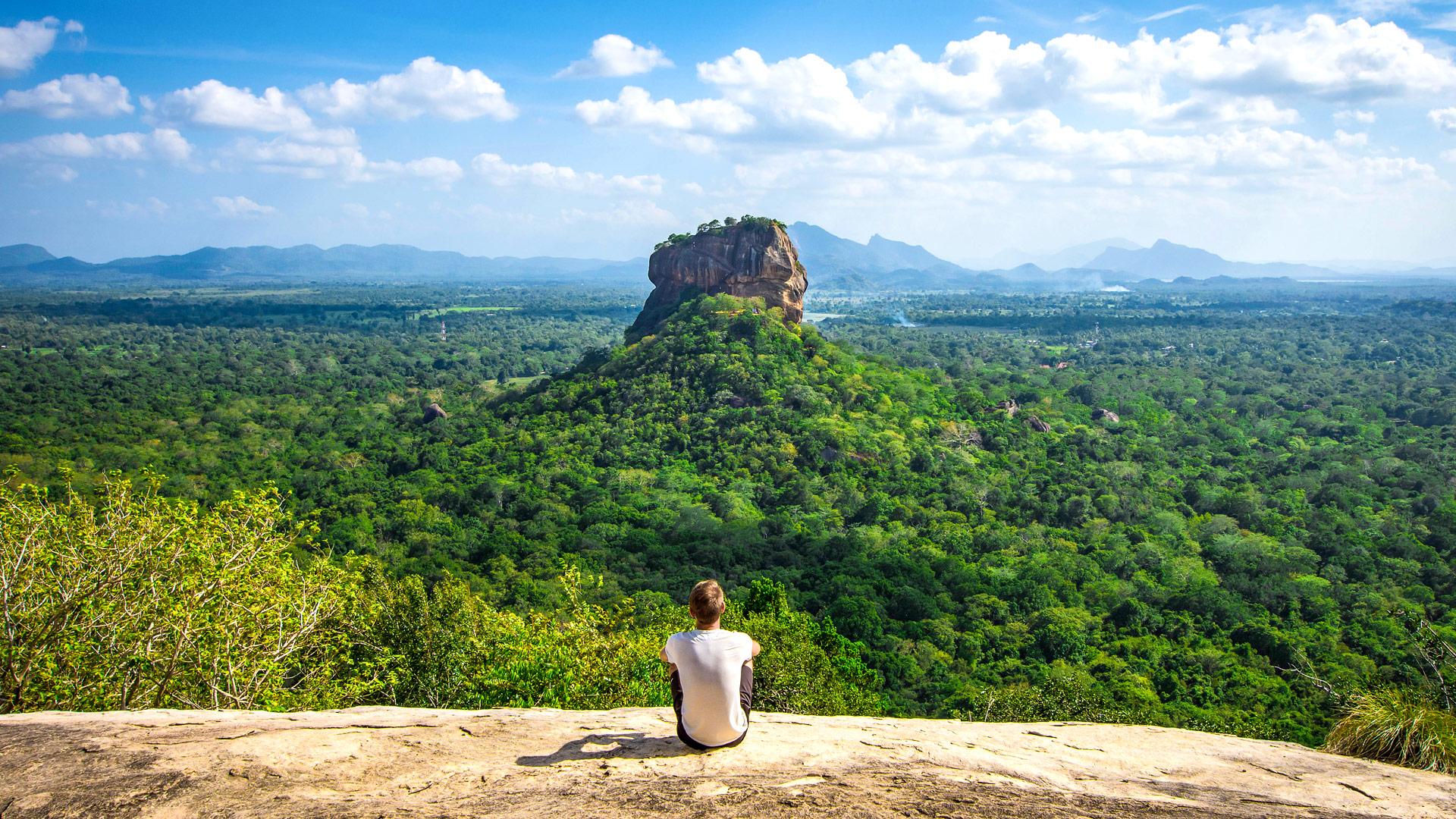
Pidurangala Rock sits just 1.5 km north of Sigiriya and offers the single best elevated view of Sigiriya Lion’s Rock, looking across from a similar height. Many travellers climb Pidurangala at sunrise (cheaper at USD 10–15 and significantly less crowded) and then descend for a ground-level walk around Sigiriya, or do both in the same morning if they start early enough.
The Pidurangala climb is rougher and less maintained than Sigiriya, expect scrambling over boulders and a short free-climb section near the top. The summit view of Sigiriya Rock at sunrise, however, is arguably the most impressive single viewpoint in the Cultural Triangle.
💡 Doing Both in One Morning
Start at Pidurangala at 6:00 AM for the sunrise view of Sigiriya, descend by 8:00 AM, drive 1.5 km to Sigiriya, and enter at 8:00–8:30 AM while it is still relatively quiet. This is a full morning but entirely achievable if you are reasonably fit. A private driver makes the logistics straightforward.
Timing a Sigiriya sunrise visit as part of a broader Cultural Triangle itinerary requires some planning, early starts, coordinating Dambulla, Polonnaruwa, and a Minneriya safari in the same area. If you are organising it independently, the logistics are manageable. If you would like someone who knows the timings well to put it together, Coastline Lanka Travels have been guiding the Cultural Triangle circuit since 2018 and can advise on the most efficient sequence around your travel dates.
Frequently Asked Questions
The Sigiriya gates open at 7:00 AM and the site closes at 5:30 PM. Arriving at exactly 7:00 AM is the single most effective way to avoid crowds and experience the rock in the best morning light. The first hour after opening is dramatically quieter than any other time of day.
International adult entry costs USD 30 per person in 2026. Children aged 6–12 pay USD 15. Children under 6 enter free. SAARC nationals (India, Pakistan, Bangladesh etc.) pay USD 15. Sri Lankan citizens pay LKR 50. The Cultural Triangle Round Ticket at USD 50 covers Sigiriya plus Polonnaruwa, Anuradhapura, and other sites.
The climb is moderate, suitable for most reasonably fit adults and older children. It involves steep metal staircases, narrow ledges, and one exposed section near the summit with iron steps on near-vertical rock. People with a significant fear of heights may find the final section challenging. The climb takes 45–60 minutes up and a similar time to descend.
Yes, Sigiriya is worth visiting at any time of day. The sunrise timing is recommended primarily to avoid crowds and heat, not because the experience is fundamentally different. A late afternoon visit arriving around 3:00–3:30 PM is a good alternative that avoids the midday rush and catches the golden hour light on the summit.
Yes, licensed guides are available at the main gate and add significant value to the visit by explaining the history of each section and pointing out features you would otherwise miss. Agree a price before starting, typically LKR 2,000–4,000 for a 2-hour tour. Your hotel or tour operator can also arrange a licensed guide in advance.
Bring at least 1.5 litres of water per person, sunscreen, a hat, and comfortable closed-toe shoes with good grip. Leave large bags at the free deposit point at the base of the Lion staircase. There are no food vendors on the rock itself, eat breakfast beforehand if doing the sunrise climb.
More Sri Lanka Travel Guides
The Perfect 12-Day Sri Lanka Itinerary with Private Driver
Best Time to Visit Sri Lanka: Month-by-Month Weather & Festival Guide
Kandy to Ella Train: Complete Booking & Best Seats Guide 2026
Climbing Sigiriya on Your Sri Lanka Trip?
If Sigiriya is part of a Cultural Triangle itinerary, we can build a sequence that covers Dambulla, Pidurangala, Sigiriya, Polonnaruwa, Anuradhapura, and a Minneriya safari in a logical order with the right timing at each site. No early starts wasted, no peak-heat visits to major monuments. Get in touch and we will plan it around your dates.